
RNA Vaccine Regulatory Workshop
On 28 and 29 July 2026, 17 national regulatory authorities from across Latin America and the Caribbean came together to work through the regulatory pathways that guide RNA vaccines from the laboratory to public health. The aim was to build reviewer fluency in RNA-vaccine science and to promote regulatory convergence — from the technical basis of the platform through emergency development, reliance, and RNA-specific GMP inspection. Full Report ENGLISH Full Report SPANISH Day 1 SlidesDay 2 Slides |
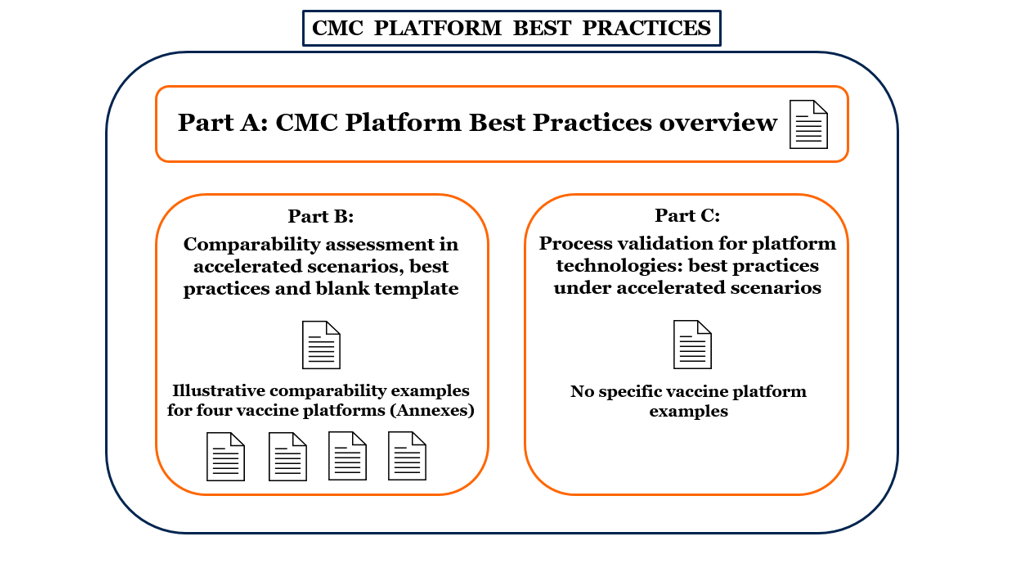
CMC Platform Best PracticesThe Coalition for Epidemic Preparedness Innovation's (CEPI) 100-day mission represents one of the most ambitious and consequential targets in pandemic preparedness, requiring vaccine developers to overcome substantial Chemistry, Manufacturing and Controls (CMC) challenges as soon as a pandemic or outbreak threat emerges. CEPI assessed the vaccine development pathways from COVID-19 to identify principles and enablers that could help shorten timelines from approximately one year to 100 days. Achieving this will require compressed and parallel CMC activities while maintaining vaccine quality, safety, and efficacy. The use of prior knowledge through established platform technologies is therefore a key enabler. CEPI's Regulatory CMC department established the CMC Platform Best Practices initiative in 2022 in collaboration with global CMC and regulatory experts. A set of documents built under the CMC Platform Best Practices project provides a strategy-oriented CMC framework with approaches to efficiently assess comparability and to perform manufacturing process validation for newly developed vaccines which pertain to a platform technology. The documents focus on four vaccine platforms: mRNA, viral vector, subunit protein, and inactivated virus. They are organized into three parts and comprise seven documents:
Part A: CMC Platform Best Practices Overview Part B: 1 Comparability assessment in accelerated scenarios, best practices and blank template 2 Comparability example template: Inactivated Virus 3 Comparability example template: mRNA 4 Comparability example blank template: Viral Vectors 5 Comparability example template: Protein subunit Part C: Process validation for platform technologies: Best Practices See more detail about this project here: CMC Platform Best Practices Summary Report |
Pandemic Preparedness and Response, Vaccine Development Ecosystem Strengthening and Use of Innovative Regulatory Approaches when Efficacy Studies are not FeasibleThe Asia-Pacific Regional Summit (10–12 March 2026, New Delhi, India) convened scientific leaders, regulators, ministries of health, manufacturers, researchers, technical experts and global partners to strengthen pandemic preparedness and response through (1) an end-to-end vaccine development ecosystem approach and (2) innovative regulatory approaches when traditional efficacy studies are not feasible. The program combined plenary and technical sessions, interactive breakouts, and disease-focused case studies (chikungunya, Nipah, and Kyasanur Forest disease (KFD)) to translate recent lessons—particularly from COVID 19—into practical actions for the region. |

The Next Public Health EmergencyWorkshop Recommendations on How Regulatory Agencies and Vaccine Developers Across the World Can Be Better Prepared
This article summarizes the work (including a series of workshops) the CEPI Regulatory and Quality Team has been doing to support the use of platform technologies, the Accumulus cloud-based information sharing tool, and other regulatory innovations across the Global South. |

How to accelerate the supply of vaccines to all populations worldwide?
This article reflects on lessons from the COVID-19 pandemic to accelerate global vaccine access, emphasizing regulatory agility, collaboration, and risk-based approaches. It compares challenges faced by early and later vaccine manufacturers, highlighting successes like reliance on trusted regulatory approvals, digital solutions, and streamlined processes. Post-pandemic shifts to rigid requirements, however, risked supply chain delays. The paper advocates sustaining flexible frameworks, harmonized standards, and global cooperation to ensure rapid response in future crises. Ideal for public health professionals, regulators, and industry stakeholders seeking insights into optimizing vaccine development and distribution. |

A roadmap for fostering timely regulatory and ethics approvals of international clinical trials in support of efficient global health research
A panel of international experts in clinical research proposes key actions to improve coordination and streamlining of regulatory and ethics review. Streamlining and harmonising review processes, while ensuring rigorous scientific standards, proper safety, and ethical oversight, is crucial for efficient, robust, and timely multinational trials. AVAREF joint regulatory and ethics reviews are highlighted as an outstanding example. Robust regulatory and ethics review systems thrive on continuous learning and efficient processes, crucial for high-quality research. |
Advancing local manufacturing capacities for vaccines within Africa
|

Expanding Master Files for human medicinal products in the EU/EEA
CEPI and EFPIA collaborated to author a regulatory position paper on master files in the EU. A new “Pharmaceutical Master File” overarching model is proposed that encompasses existing master files procedures as well as expanded approaches not in place today. The flexible and modular Pharmaceutical Master File aims at enabling faster access to novel medicines, including vaccines. |