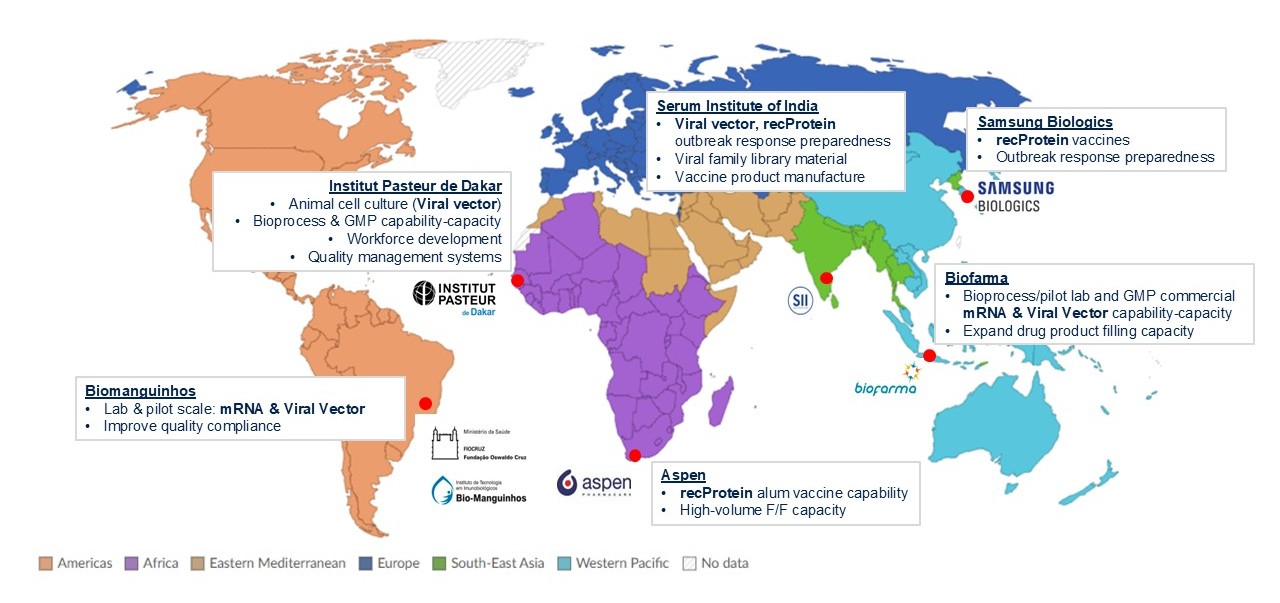
The Vaccine Manufacturing Facilities Network (VMFN) is a CEPI initiative designed to help the world respond more equitably and quickly to future disease outbreaks. During COVID-19, vaccine production was concentrated in a small number of predominantly high-income countries, which left many lower- and middle-income countries waiting too long for access. The VMFN aims to change that by building a more geographically distributed network of vaccine manufacturing partners, especially across the Global South, so more regions can produce vaccines closer to where they are needed.Through the VMFN, CEPI supports manufacturers with funding, technical expertise, and connections across the global health ecosystem. In return, CEPI secures access to vaccine production capacity that can be used during emergencies, with the goal of making outbreak vaccines more available and affordable for lower-income countries. In simple terms, the network is about preparedness, resilience, and fairer access.What VMFN doesVMFN focuses on three things: strengthening regional vaccine manufacturing, creating sustainable production capacity that can be activated during outbreaks, and helping transfer rapid response vaccine technologies to partners in different parts of the world. Today, the network includes six manufacturing partners across Africa, Asia, Latin America, and the Western Pacific.Together, they cover several modern vaccine technologies, including mRNA, recombinant protein, and viral vector platforms. CEPI’s agreements with these partners help ensure that a portion of their manufacturing capacity can be made available for future outbreak response. |
The network facilities:
| VMFN Partner | WHO LMIC Region | Modality Status at each VMFN Partner | ||
| mRNA | rProtein | Viral Vector | ||
| Aspen (drug product f/f only) | Africa | |||
| IPD | ||||
| Serum Institute of India | SE Asia | |||
| BioFarma | ||||
| Fiocruz-BioManguinhos | LAC | |||
| Samsung Biologics | W Pacific | |||
| Key: | Developed | Developing | To be developed |
VMFN – What, Why, How, With Whom & How We Measure SuccessCEPI has a unique role of catalyst and enabler. We:
|
|
WHY CEPI invests |
WHAT CEPI is trying to achieve |
HOW CEPI enables success for the VMFN |
WITH WHOM CEPI collaborates |
HOW success is measured |
|
Strengthen pandemic preparedness through geographically diversified manufacturing capacity |
End‑to‑end outbreak manufacturing readiness (DS, DP, F/F) |
Long‑term funding agreements (10 years) with priority access clauses for outbreaks |
Manufacturers in the Global South (existing and emerging) |
Reserved, accessible manufacturing capacity for outbreak response |
|
Enable: |
Sustainable inter‑pandemic use of CEPI‑supported capacity |
Support across: |
Global & regional partners (e.g. WHO, Gavi, RVMC, MDBs) |
Demonstrated readiness across multiple vaccine platforms |
|
Address gaps exposed during COVID‑19 by ensuring ready‑to‑deploy surge capacity |
Regional manufacturing resilience aligned with the 100 Days Mission |
Target existing and well-established manufacturers |
National governments & regional bodies |
Use of CEPI‑supported capacity between pandemics |
|
Influence policies and actions supporting manufacturing geodiversification |
Complementarity with other CEPI initiatives & regional investments |
Industry and manufacturing networks (e.g. DCVMN) |
Improved regional equity in vaccine manufacturing and access |